
Carson City City Directory Collections
Carson City has documented directory leads from the territorial era through later reverse-directory work, but no single shelf supplies every year. The Carson City-specific directory listing identifies 1862, 1863, and 1868/69 directories, the 1871-72 Storey, Ormsby, Washoe, and Lyon Counties Directory, and Carson City volumes for 1937 and 1938. The Library of Congress explains that city directories were often compiled door to door and may carry a name, address, telephone number, occupation, business, or institution. Their issue pattern was irregular, so a blank year is not evidence that a household vanished.
| Directory source | Dates documented | Where to start | Access note |
|---|---|---|---|
| Carson City directories | 1862, 1863, 1868/69 | Established library and Ancestry collection listings | Confirm the image, repository, and page before citing it |
| Storey, Ormsby, Washoe, and Lyon Counties Directory | 1871-72 | Carson City directory listing and regional repositories | County-level coverage, not a guarantee for each address |
| Carson City directories | 1937 and 1938 | Established library and Ancestry collection listings | Verify the volume's actual image availability |
| Reverse-directory research | 1965, 1970-2018 selected runs | Carson City Brown Street planning/research report | Developed-area and central-city limits apply |
| Bell Telephone directory lead | 1926 | Nevada Historical Society rare-print list | A flyer is a lead, not an identified resident list |
The Library of Congress city-directory guide is helpful for interpreting the form of a volume. For Carson City, the practical next step is to capture the collection name, volume year, page number, and image source with every finding. A repository description is not the same as a readable page.
Carson City City Directories and Ormsby
Historical labels matter in Carson City directory research. Carson City was Nevada's territorial capital in 1861 and remained the capital after statehood in 1864. The modern jurisdiction did not exist in the same form for all of those years: Carson City and Ormsby County consolidated effective July 1, 1969. A catalog, newspaper, index, or directory may therefore file a relevant item under Ormsby County rather than Carson City. Preserve the form printed in the source and search both terms before calling a volume missing.
| 1861 | Carson City became the Nevada Territory capital. |
|---|---|
| 1862-63 | Early Nevada territorial directory leads include Carson City material. |
| 1864 | Nevada statehood, with Carson City continuing as capital. |
| 1969 | Carson City and Ormsby County consolidated, changing the jurisdiction label for later searching. |
This date sequence is a useful numbers check before starting a local historical-directory search. An outlying address may also be missed because a volume centered on the developed core, because a postal label crossed a practical boundary, or because the volume itself is absent. None of those possibilities proves that no one was there.
Note: Record the jurisdiction printed in each item before adding a modern Carson City cross-reference.
Carson City City Directory Research Desks
The local route starts with the Carson City Library, 900 N Roop Street, where the catalog can be filtered by collection, format, publication date, and other fields. The inspected catalog text did not identify every directory, obituary index, or microfilm run. Ask the reference desk for the exact title, year, format, and call number instead of assuming a catalog hit is a city directory. The library's digital-resources route also points to Nevada Library Cooperative historical newspapers and oral-history material, though it does not say that every Carson City directory has been digitized.
For municipal originals and historical lists, the Carson City Clerk-Recorder historical-records route describes historical books from 1862-1985 and loose records from the 1800s to the present. The genealogy holdings at the courthouse add selected birth, death, citizenship, health-report, and cemetery material. The Nevada State Archives and UNR Special Collections are the next stops for regional microfilm and finding aids. Bring a surname, date range, and the historical label, then record the repository and container details with the result.
The Library of Congress city-directory guide pictured here is a useful starting reference when a Carson City volume is available only as a catalog or microfilm lead.
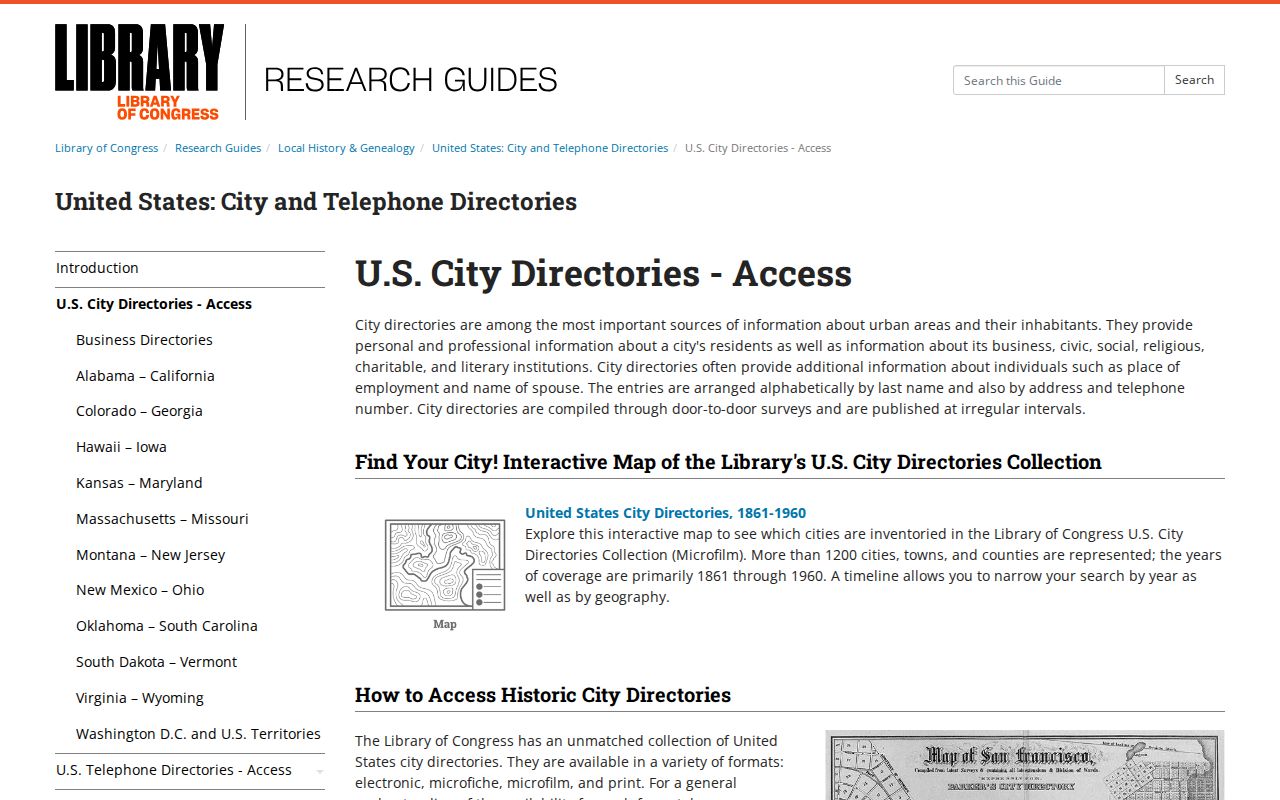
The guide helps distinguish a directory image from a repository listing. Carson City research still needs the exact volume, year, and page that supports a particular name or address.
Carson City Library
900 N Roop Street, Carson City. Call (775) 887-2244 to ask about a title, year, and format before a visit.
Clerk-Recorder Genealogy
Original local genealogy materials are at 885 E Musser Street, Suite 1025. The research page lists (775) 887-2084.
Nevada State Archives
Use its Ask an Archivist route for state-level records and finding-aid help when a city listing stops short.
Reading a Carson City City Directory
Read a Carson City city directory line as a compact, dated record. The Library of Congress notes that directories can contain names, street addresses, telephone numbers, occupations, businesses, and institutions, but each volume chooses its own shorthand. A person may appear as a householder, an office contact, a business operator, or a boarder. Those are different relationships. First photograph or note the title page and any abbreviation key, then transcribe the line exactly before expanding the search to another year.
| Name | The printed person or business name. Check initials, spelling variants, and the order used in the volume. |
|---|---|
| Address | The street address or business location shown for that edition, not proof of an unbroken stay. |
| Occupation or institution | A useful identity clue that may separate people with the same name. |
| Telephone or business line | Information that may be present in a particular directory, but must be read in its historical context. |
| Abbreviation | Volume-specific shorthand. Use the printed key rather than importing a meaning from another publisher. |
- Criss-cross directory
- An address-ordered directory, often called a reverse directory, that starts with a street and number rather than a name.
- Householder index
- A name arrangement that helps locate the household listing, but does not necessarily list every person at an address.
- Abbreviation key
- The publisher's explanation of compressed labels. It should be read with the same volume because the meanings can vary.
The 1865 Carson City Directory Gap
A local records story can explain why an address trail needs more than one directory volume. A Carson City fire-history source records an August 18, 1865 fire that destroyed a full block between Carson and Fall Streets and Fourth and Fifth Streets, with an estimated $25,000 loss. A directory date on either side of that event may identify a business or household lead, but it cannot by itself show how a specific parcel or family changed after the fire.
Use the directory date with the issue date in a Chronicling America Nevada newspaper title search. Notices about a fire, business moves, probate, marriages, or land can add context, and the Nevada State Library's Carson Appeal index covers selected 1865-66, 1879-81, and 1885-86 runs. Search the cross streets as well as the surname. A block match is still only a location clue until a dated record supplies the person-to-address connection.
Note: Use the issue date printed in a newspaper scan, not only the broader catalog date range.
Trace Families With Carson City City Directories
Follow a household one documented year at a time. A Carson City city directory may show a changed address or occupation between census decades, while a deed, cemetery index, or newspaper can test what that change means. The official Brown Street research is particularly useful as a method example: it used reverse directories from 1965 through 2018 in selected years, and it warns that the books focused on developed areas and that older editions may concentrate on central Carson City. An absent entry therefore needs a coverage check before it becomes a conclusion.
- Locate the first dated listing and copy the name, address, occupation, volume year, page, and repository.
- Check the next available directory rather than assuming every intervening year exists.
- When an address is known, consult the reverse or criss-cross run to see whether that edition lists an occupant there.
- Pair the dated directory line with the nearest released federal census and keep the source dates separate.
- Use a newspaper, cemetery entry, deed, or archive request to test a move, death, business change, or name collision.
A later address is a good reason to verify one person across official indexes, but it is not a private profile. When the goal shifts to a current official record, the Carson City resident lookup route uses a different, person-centered method.
Carson City City Directory Clues in Newspapers
Newspapers can bridge the space between two Carson City city directories. Chronicling America lists Carson City Daily Appeal, Carson Daily Appeal, The Carson Daily Appeal, Daily State Register, and The Daily Appeal titles. Use a date from the directory as the starting point, then search the displayed issue for an obituary, marriage, probate notice, land notice, school item, church item, or fire report. The State Library Carson Appeal index also explains abbreviations such as CDA, MA, and CDI, which can make a citation easier to read accurately.
Do not turn a newspaper mention into a permanent residence claim. A notice may concern a business, a visitor, a public meeting, a court matter, or a relative. Keep the title, issue date, page, and the exact relationship stated in the text. For a historic address, pair that citation with a directory or recorded instrument that carries its own date.
Carson City Genealogy Record Limits
City directories work best beside the Clerk-Recorder genealogy categories, not in place of them. The local genealogy page lists births from 1867-1957, deaths from 1887-1957, Public Health Officer reports from 1911-1941, citizenship records from 1868-1926, and cemetery indexing from 1850 to the present. These lists are expressly incomplete. It also warns that Chinese names may be indexed under variants or twice, so try alternate spellings, initials, given-name order, and known name forms before treating a failed search as final.
Capture what the source actually proves. An index can establish a lead; an underlying image, ledger, newspaper, or eligible official record may be needed for the detail. For modern Nevada birth and death certificates, access is controlled by NRS Chapter 440, including the general 125-year birth and 50-year death release periods. Treat restricted records and protected addresses as limits to respect, not gaps to work around.