
Carson City Previous Residents Sources
Different sources answer different parts of the Carson City address story. The Assessor's Property Inquiry and Sales Search & Export can tie a current location to a parcel ID, sale date, sale price, and document number. Landmark then supplies an index route to the recorded instrument. For past residents, reverse directories, ordinary city directories, released census material, newspapers, cemetery lists, and local genealogy files add household leads. A deed is strong evidence of a recorded transaction. It does not automatically identify everyone who lived at the address.
| Source | Years it can cover | Where held | What it can show |
|---|---|---|---|
| Property Inquiry and Sales Search | Current portal fields; historical depth varies by displayed record | Carson City Assessor portal | Parcel, owner label, situs, sale fields, and document-number lead |
| Landmark recorded-document index | Online images begin in 1962 | Carson City Clerk-Recorder and Landmark Web | Party, date, book/page, instrument, and legal-search lead |
| Reverse directories | 1965, 1970, 1975-2018 selected runs | Brown Street planning/research method and local repositories | Address-ordered household leads within documented coverage |
| Historical city-directory leads | 1862, 1863, 1868/69, 1871-72, 1937-38 | Listed library and collection routes | Dated names, addresses, occupations, and business clues |
| Genealogy and cemetery material | Cemetery 1850-present; selected death index 1887-1957 | Carson City Clerk-Recorder genealogy route | Older family and end-of-life research leads, with stated gaps |
Start with the period that matters. For a recent change, use the parcel and recorded-document route. For a mid-century household question, check whether a reverse directory exists for the year. For an earlier question, treat a directory listing, newspaper, or local genealogy index as a dated lead and record its repository. The Clerk-Recorder genealogy route is a useful local fallback for selected historical series.
Carson City Previous Residents in Landmark
Use the official Carson City Landmark Web as an index, not as a conclusion. It offers Name, Document, Book Page, Record Date Range, Instrument Number, and Legal Search modes. The city instructions say to use one method at a time. For an address trail, bring the parcel ID or document number from the Assessor search, then compare the date, parties, legal description, and document type before treating an instrument as part of the chain. Search names with spelling variants and initials when the index's wording calls for it.
The Landmark recorder index screen captured here shows the available search paths and helps explain why a document number is a better bridge than a name alone.
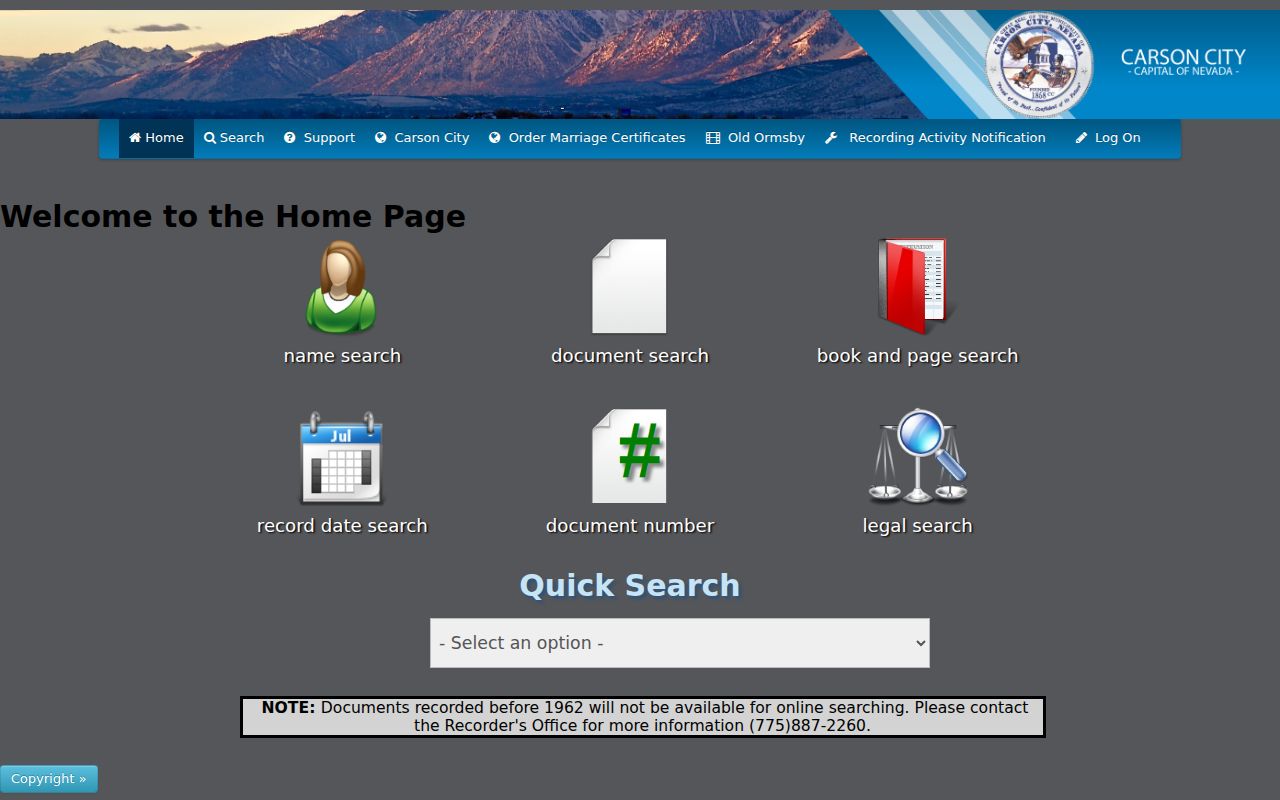
Record the search mode and the instrument number with each result so the chain can be repeated. Documents recorded before 1962 are not available online. For that earlier range, call the Recorder at (775) 887-2260 or ask for the paper and staff route at the Clerk-Recorder rather than assuming the online gap means no deed exists.
Landmark's warning is important: the index works like a library card catalog and can change. A name hit can represent a trust, entity, release, reconveyance, or another non-occupancy event. Inspect the instrument or obtain the specific record from its custodian when the legal effect matters.
Carson City Previous Residents and Ormsby
Use both Carson City and Ormsby County for a historical address trail. Carson City became a consolidated municipality with Ormsby County effective July 1, 1969, so a pre-consolidation deed book, directory, archive guide, or newspaper may be labeled Ormsby even when the modern place is Carson City. Keep the original label in the research log. Replacing it silently with a modern one can hide the search path that led to the record.
This is also a date check. Territorial and early statehood material may be held in regional archives, while the online document boundary at Landmark begins in 1962 and voter-file access begins in 1996. Each change shifts the best source. A continuous address history needs an actual record for each interval, not a guess drawn across a jurisdiction or online-index gap.
Note: Search the historical place name separately before deciding an older Carson City address has no record trail.
Trace Carson City Previous Residents by Deed
A practical deed chain begins with the physical parcel, not with a guessed resident name. The Carson City Property Inquiry accepts Parcel ID, Owner Name, address-number ranges, and Street Name. Its guidance recommends an eight-digit parcel number when known and suggests omitting the street suffix for broader matching. Sales Search & Export can narrow by address, parcel, document number, sale date, sale price, subdivision, and other displayed fields. Carry a shown document number to Landmark, then use the recorded document itself to test the transfer.
- Search the address in Property Inquiry and save the displayed parcel ID, situs address, owner label, sale fields, and document number.
- Open Landmark and search the document or instrument number, or use the Recorder APN syntax without hyphens or leading zeroes.
- Read the parties, record date, document type, book/page, and legal description. A sale field alone does not describe the whole transfer.
- Use the prior party and the recorded details to find the earlier acquisition, checking name variants where needed.
- Repeat only when the next instrument supports the link. For pre-1962 work, request the paper or staff route from the Recorder.
- Grantor
- The party conveying or releasing an interest in a recorded instrument.
- Grantee
- The party receiving an interest in a recorded instrument.
- Chain of title
- A sequence of recorded instruments used to follow interests in a parcel across time.
- Legal description
- The parcel description in the instrument. It is more durable than a street address when a record uses an older form.
Carson City Previous Residents in Directories
Past residents and past owners can diverge. The official Brown Street planning/research report used reverse-directory years 2018, 2014, 2010, 2005, 2000, 1995, 1990, 1985, 1980, 1976, 1975, 1970, and 1965. Its warning is just as useful as its dates: reverse directories concentrate on developed areas, and earlier books may cover central Carson City rather than the full municipality. An address missing from one volume may reflect the volume's footprint rather than an empty parcel.
Use ordinary city directories for name-first work and a criss-cross or reverse directory for address-first work. The historical collections, repository leads, and how to read an entry are gathered on the Carson City city directory route. For each year, copy the address exactly as printed, note the directory title and page, and keep its date beside the deed or assessment-roll year rather than merging them into one undated story.
The Library of Congress city-directory guide shown here is a useful route for a Carson City previous-resident search when the needed volume is a microfilm or catalog lead.
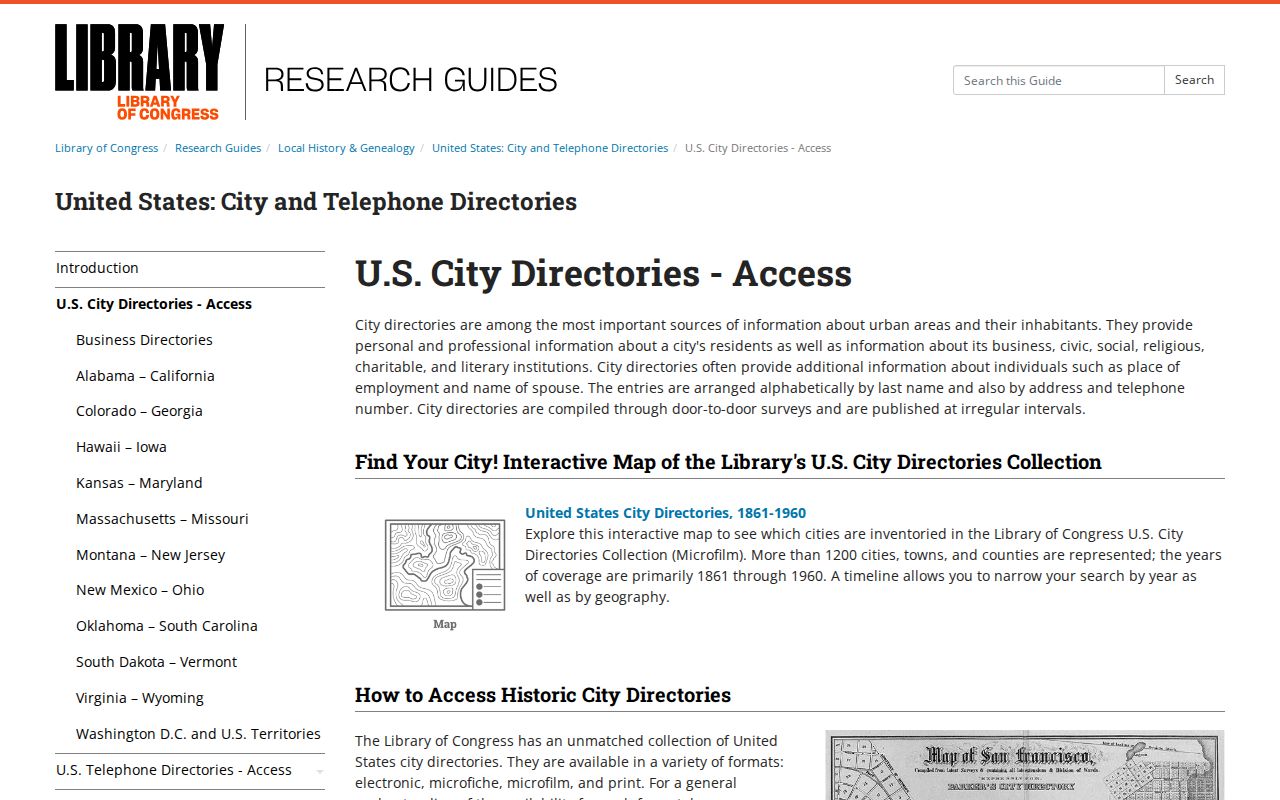
Use the guide to locate the correct kind of directory, then preserve the actual volume and page information with the address finding.
- Choose the available directory nearest the transaction or census date.
- Find the address in the reverse arrangement when that volume provides one.
- Check the name arrangement for the same year and compare the printed address and occupation clues.
- Pair the result with the nearest released census, preserving the different record dates.
- Use a deed, cemetery entry, obituary, or archive record to test why the household changes or disappears.
The 1865 Carson City Address Break
An address history can break because the built environment changed, not because a researcher missed a name. Carson City's fire history records that an August 18, 1865 fire destroyed a full block between Carson and Fall Streets and Fourth and Fifth Streets, with an estimated $25,000 loss. A later structure or listing near that block needs a dated source to establish its connection. The fire is a reason to widen the search to cross streets, newspaper notices, and recorded property material, not a reason to assume a particular building history.
Historic-resource records can also frame a careful question. The Nevada State Historic Preservation Office report documents Carson City examples including the Alfred Chartz House, Abraham Curry House, GWG Ferris House, Lew M. Meder House, and James D. Roberts House. Those examples show the kind of construction, owner, movement, restoration, and repository detail that can be assembled when a specific property is documented. They do not establish facts about an unlisted address.
Carson City Previous Residents Beyond Deeds
Newspapers and municipal records can resolve a change between two deed or directory dates. Chronicling America lists Carson City Daily Appeal and related Nevada titles; use a known address, cross street, surname, or date range, then cite the exact issue date. Obituaries, probate notices, land notices, and fire reports may explain a transition, but each describes only what it says. A newspaper item should not be used as proof of an unbroken residence.
For a property file that needs permits, plans, inspections, code cases, maps, or meeting material, use the Carson City public-record route with the address or APN and a narrow date range. The city's form can be sent by email to recordrequests@carsoncity.gov, by mail to Public Records, 885 E Musser Street #1028, Carson City, NV 89701, or by fax at (775) 887-2146; the public-records page lists (775) 887-2217. It gives a response target no later than the end of the fifth business day under Nevada Public Records Act, NRS Chapter 239. A request may lead to electronic production, inspection, an estimate, a referral, or a later date. Ask for identified record categories, not every item associated with a house.
Carson City Past Households and Limits
For older Carson City past residents, local genealogy categories offer a separate family-history layer. The Clerk-Recorder lists birth records for 1867-1957, death records for 1887-1957, Public Health Officer reports for 1911-1941, citizenship records for 1868-1926, and cemetery indexing from 1850 onward. The lists are not complete, and Chinese names may appear under variants or twice. Search alternate name forms and preserve the source's wording before matching an index lead to a directory or address.
A cemetery, obituary, probate file, or directory can help close a dated trail, but it does not license a claim about a living person. Nevada's vital-record access rules in NRS Chapter 440 protect recent records, with general release periods of 125 years for births and 50 years for deaths. A protected address, withheld information, or sealed material is a limit to honor.
Lawful use. Carson City previous-resident research is appropriate for house history, family history, heir research, and personal curiosity. Do not use a record trail to stalk, harass, track, or harm a living person.